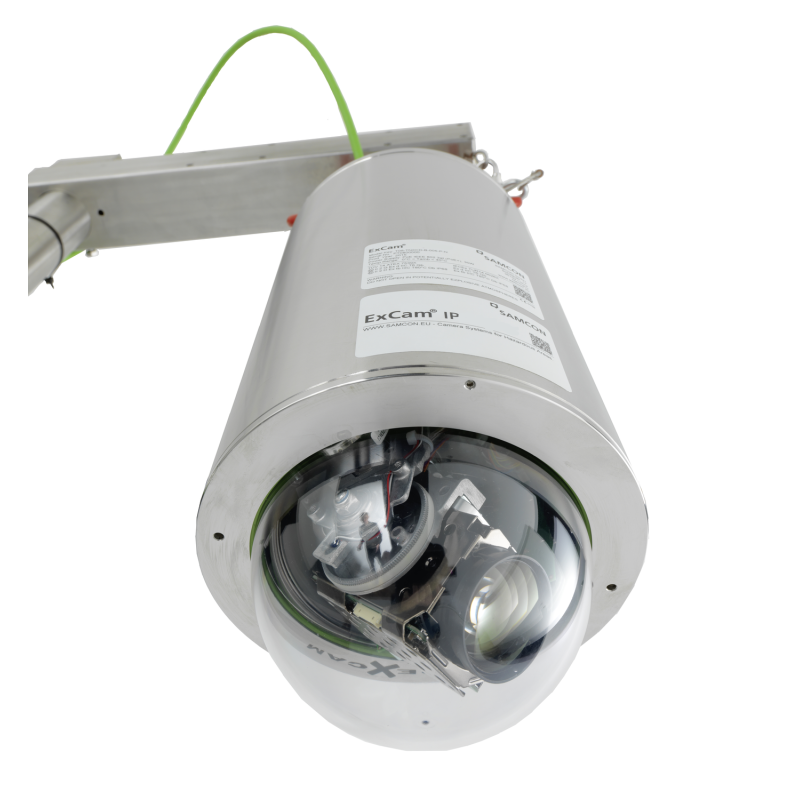
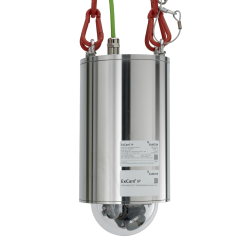
The ExCam IPP5655 is a high-performance 2-megapixel IP dome camera for use in hazardous areas. It not only offers excellent HDTV resolution (1920 x 1080), but also powerful motorized zoom and a 32x optical autofocus lens. The camera allows for continuous 360° rotation. A particular highlight is the camera's precise and fast pan and tilt capabilities. The ExCam series is certified in accordance with European (ATEX) and international (IECEx) regulations. These and more available certificates can be found in the download area on the manufacturer's website.
Features.
- Wide range of certifications for hazardous areas (ATEX, IECEx, EAC-Ex, and others)
- Single cable solution (PoE / 24VDC)
- Ingress protection: IP68 (IEC 60529)
- High resolution: 1920x1080 (HDTV 1080p)
- Powerful motor - zoom - autofocus - lens (32x optical)
- Lightfinder and WDR technologies
- Focus recovery and EIS (electronic image stabilization)
- Easy integration with VMS
- Extensive accessories
Ex-proof dome camera with ATEX, IECEx, and EAC-Ex certifications
The ExCam series is certified in accordance with European (ATEX) and international (IECEx) regulations. Housing certification covers ATEX Group II for Zones 1, 2, 21, and 22, along with Explosion Groups IIC/IIIC. It also has EAC-Ex and IA certifications.
During the development of the ExCam IPP5655, a clear emphasis was placed on safety aspects, including mechanical precision and high-quality stainless steel, as well as a modular design that allows, for example, direct connection of an FOC. For large-scale observations, the FOC offers high transmission speeds.
Media Resistance and Seals
Thanks to the high-quality materials used in the ExCam series (316L stainless steel / CF-3M), it meets a comprehensive list of media resistance requirements. The specially designed optical bubble is made of LEXAN© polycarbonate, which not only withstands the lowest temperatures but also has excellent optical properties, such as very low optical distortion. The camera's protection class is IP-68.
Temperatures
The ExCam IPP5655 also sets new standards in terms of permissible ambient temperature: When heated, the temperature limit is -50°C to +60°C. To ensure frost-free operation at -50°C, two PTC ceramic materials are used for heating (see the relevant model code).
Lower installation costs and power supply via Ethernet (PoE)
A special feature of the ExCam IPP5655 is that data streams and power are transmitted over a single cable, meaning that only a PoE switch or PoE midspan is required for installation in a secure area. Because the camera is powered via Power over Ethernet (PoE compliant with IEEE 802.3at), the costly installation of a separate power supply is not required.
HD CCTV camera in explosion-proof housing
Measurements: 378 mm long and only 195 mm in diameter, the ExCam IPP5655 is smaller than some cameras designed for use in safe areas, but with more advanced features. Thanks to its progressive scan function, the ExCam IPP5655 captures high-resolution images of moving objects at up to 30 frames per second: without motion blur! The ExCam IPP5655 also provides sharp images in Full HD resolution.
Day/Night Function
The ExCam IPP5655 camera features day/night functionality, making it particularly suitable for use outdoors or indoors in low-light conditions. When brightness drops below a certain level, the camera automatically switches to night mode to produce high-quality black and white images using infrared. Infrared light with a wavelength between 780 and approximately 1000 nanometers cannot be perceived by the human eye, but the ExCam IPP5655 image sensor can recognize and utilize this light.
Auxiliary Contacts
The ExCam IPP5655 camera can be flexibly equipped with additional cables that can connect external digital auxiliary contacts to the camera logic. For example, external contacts can be used to start or stop video recording, or to clean the camera's optical flange using a compressed air or water spray relay.
Benefits of Digital Network Video Surveillance
An IP network video surveillance system offers many advantages and special features.
Benefits include remote access, high image quality, event management, intelligent video features, easy integration, improved scalability, flexibility, and cost-effectiveness.
• Remote Access
• High Image Quality
• Event Management and Intelligent Video
• Easy, Secure, and Resilient Integration
• Scalability and Flexibility
• Cost-Effectiveness
Access Remote
Network cameras and video encoders can be accessed and configured remotely, allowing multiple authorized users to view live and recorded video at any time and from any network location worldwide. This is an advantage when you want to grant third-party users, such as a security company, access to the video images.
High Image Quality
In video surveillance systems, high image quality is essential to clearly identify people or objects involved. Thanks to progressive scan and megapixel technology, the IPP5655 offers significantly better image quality and higher resolution than any analog CCTV camera. Furthermore, it is much easier to ensure image quality in an IP network than in an analog system.
In current analog systems that use a recorder as the recording device, numerous data conversions from analog to digital and vice versa occur: first, the camera converts analog signals to digital data, which are then converted back to analog for transmission. The analog signals are then digitized again for recording. Each conversion procedure, as well as signal attenuation, affects image quality. The longer the transmission distance of these analog signals, the weaker the signal becomes. In a fully digital IP surveillance system, images from a network camera are digitized only once and then remain in digital format. This not only avoids unnecessary conversions but also image degradation caused by long network transmission distances. Furthermore, digital images can be stored and retrieved more easily than analog videotapes.
Event Management and Intelligent Video
Often, excessive amounts of video data are recorded without enough time to properly analyze it. Advanced network cameras and video encoders with integrated intelligence or analytics solve this problem by reducing irrelevant video recordings and initiating pre-programmed actions. Such features are not available with analog systems.
The ExCam IPP5655 camera offers integrated features such as video motion detection, active tamper protection, and alarm and event management. Thanks to these features, network cameras and video encoders can continuously analyze input data to detect events and automatically respond—for example, by initiating video recording and sending alarm notifications.
Event management functions can be configured via the user interface or network video software. Users can define alarms or events based on the trigger used and specify the period during which the event should be active. In addition, actions can be configured (e.g., recording one or more locations, locally and/or remotely, activating external devices such as sirens, lights, and door openers, sending notifications to users).
Easy, secure, and robust integration
Network video products based on open standards can be easily integrated with video management and application software.
Scalability and flexibility
A network video system can grow with your needs. With IP-based systems, multiple network cameras and video encoders, as well as other types of applications, can use the same wired or wireless network to exchange data.
This allows a variable number of network video products to be added to the system without requiring extensive or costly changes to the network infrastructure. This is not possible with an analog system, as such systems require a specially designed coaxial cable to be connected directly from each camera to the viewing/recording station. In comparison, network video products can be virtually placed anywhere and integrated into any network, being more or less open, or even strictly protected.
Cost-Effective
An IP surveillance system typically has lower total operating costs than a conventional analog CCTV system. In most cases, the IP network infrastructure already exists, making a network video application easily integrated into the existing infrastructure. Wired or wireless network solutions are also significantly less expensive than coaxial and fiber optic solutions used in analog CCTV systems. Administrative and hardware costs are lower because back-end storage applications and storage systems can be implemented on a non-proprietary standard server, which is designed to produce specific hardware, such as a DVR.
Advantages of Dome Cameras
The built-in pan, tilt, and zoom mechanism in off-the-shelf cameras allows for efficient heating of the housing and camera, which is particularly advantageous in low-temperature applications. Furthermore, the mechanical components are protected not only from dust but also from external damage.
Another advantage of a dome camera is that personnel injuries are prevented during operation, as all moving parts are located inside the camera housing and therefore separated from operating personnel. Compared to a classic pan-tilt-zoom system, where the axes are located outside the camera housing, this has another advantage: lower weight.
Due to their design, dome cameras are significantly lighter, which is also reflected in the lower requirements for mounting and installation equipment.
Unlike classic pan-tilt-zoom cameras, which require a risk assessment to determine the interval and scope of necessary maintenance, dome cameras are essentially maintenance-free. This also significantly reduces operating costs.