


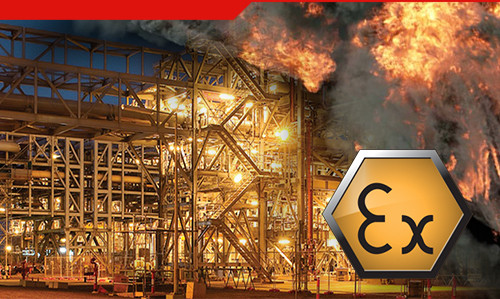
Electrical devices intended for operation in explosive atmospheres are products that incorporate design features that preclude or hinder the ignition of explosive mixtures outside the device, both during normal operation and in the event of a fault.
-
-
-
Category
-
Semiconductors
- Diodes
- Thyristors
-
Electro-insulated Modules
- Electro-insulated Modules | VISHAY (IR)
- Electro-insulated Modules | INFINEON (EUPEC)
- Electro-insulated Modules | Semikron
- Electro-insulated Modules | POWEREX
- Electro-insulated Modules | IXYS
- Electro-insulated Modules | POSEICO
- Electro-insulated Modules | ABB
- Electro-insulated Modules | TECHSEM
- Go to the subcategory
- Bridge Rectifiers
-
Transistors
- Transistors | GeneSiC
- SiC MOSFET Modules | Mitsubishi
- SiC MOSFET Modules | STARPOWER
- Module SiC MOSFET ABB’s
- IGBT Modules | MITSUBISHI
- Transistor Modules | MITSUBISHI
- MOSFET Modules | MITSUBISHI
- Transistor Modules | ABB
- IGBT Modules | POWEREX
- IGBT Modules | INFINEON (EUPEC)
- Silicon Carbide (SiC) semiconductor elements
- Go to the subcategory
- Gate Drivers
- Power Blocks
- Go to the subcategory
- Electrical Transducers
-
Passive components (capacitors, resistors, fuses, filters)
- Resistors
-
Fuses
- Miniature Fuses for electronic circuits - ABC & AGC Series
- Tubular Fast-acting Fuses
- Time-delay Fuse Links with GL/GG & AM characteristics
- Ultrafast Fuse Links
- Fast-acting Fuses (British & American standard)
- Fast-acting Fuses (European standard)
- Traction Fuses
- High-voltage Fuse Links
- Go to the subcategory
- Capacitors
- EMI Filters
- Supercapacitors
- Power surge protection
- TEMPEST emission revealing filters
- Surge arrester
- Go to the subcategory
-
Relays and Contactors
- Relays and Contactors - Theory
- 3-Phase AC Semiconductor Relays
- DC Semiconductor Relays
- Controllers, Control Systems and Accessories
- Soft Starters and Reversible Relays
- Electromechanical Relays
- Contactors
- Rotary Switches
-
Single-Phase AC Semiconductor Relays
- AC ONE PHASE RELAYS 1 series| D2425 | D2450
- One phase semiconductor AC relays CWA and CWD series
- One phase semiconductor AC relays CMRA and CMRD series
- One phase semiconductor AC relays - PS series
- Double and quadruple semiconductor AC relays - D24 D, TD24 Q, H12D48 D series
- One phase semiconductor relays - gn series
- Ckr series single phase solid state relays
- One phase AC semiconductor relays for DIN bus - ERDA I ERAA series
- 150A AC single phase relays
- Rail Mountable Solid State Relays With Integrated Heat Sink - ENDA, ERDA1 / ERAA1 series
- Go to the subcategory
- Single-Phase AC Semiconductor Relays for PCBs
- Interface Relays
- Go to the subcategory
- Cores and Other Inductive Components
- Heatsinks, Varistors, Thermal Protection
- Fans
- Air Conditioning, Accessories for Electrical Cabinets, Coolers
-
Batteries, Chargers, Buffer Power Supplies and Inverters
- Batteries, Chargers - Theoretical Description
- Modular Li-ion Battery Building Blocks, Custom Batteries, BMS
- Batteries
- Battery Chargers and Accessories
- Uninterruptible Power Supply and Buffer Power Supplies
- Inverters and Photovoltaic Equipments
- Energy storage
- Fuel cells
- Lithium-ion batteries
- Go to the subcategory
-
Automatics
- Spiralift Lifts
- Futaba Drone Parts
- Limit Switches, Microswitches
- Sensors, Transducers
-
Infrared Thermometers (Pyrometers)
- IR-TE Series - Water-proof Palm-sized Radiation Thermometer
- IR-TA Series - Handheld Type Radiation Thermometer
- IR-H Series - Handheld Type Radiation Thermometer
- IR-BA Series - High-speed Compact Radiation Thermometer
- IR-FA Series - Fiber Optic Radiation Thermometer
- IR-BZ Series - Compact Infrared Thermometers
- Go to the subcategory
- Counters, Time Relays, Panel Meters
- Industrial Protection Devices
- Light and Sound Signalling
- Thermographic Camera
- LED Displays
- Control Equipments
- Go to the subcategory
-
Cables, Litz wires, Conduits, Flexible connections
- Wires
- Cable feedthroughs and couplers
- Litz wires
-
Cables for extreme applications
- Extension and Compensation cables
- Thermocouple cables
- Connection cables for PT sensors
- Multi-conductor wires (temp. -60C to +1400C)
- Medium voltage cables
- Ignition wires
- Heating cables
- Single conductor cables (temp. -60C to +450C)
- Railway cables
- Heating cables Ex
- Cables for the defense industry
- Go to the subcategory
- Sleevings
-
Braids
- Flat Braids
- Round Braids
- Very Flexible Flat Braids
- Very Flexible Round Braids
- Cylindrical Cooper Braids
- Cylindrical Cooper Braids and Sleevings
- Flexible Earthing Connections
- PCV Insulated Copper Braids (temp. up to 85C)
- Flat Aluminium Braids
- Junction Set - Braids and Tubes
- Steel Braids
- Go to the subcategory
- Traction Equipment
- Cable Terminals
- Flexible Insulated Busbars
- Flexible Multilayer Busbars
- Cable Duct Systems
- Go to the subcategory
- View all categories
-
Semiconductors
-
-

Ochrona przeciwwybuchowa
-
 10/12/2025
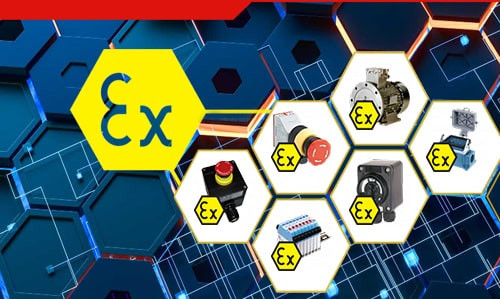
Devices Intended for Explosion Hazard ZonesRead more
10/12/2025
Devices Intended for Explosion Hazard ZonesRead more -
 10/12/2025
Explosion protection - Division into explosion-hazard zonesRead more
10/12/2025
Explosion protection - Division into explosion-hazard zonesRead moreNot all hazardous areas are created equal, so the equipment used in them is subject to different requirements. These areas are divided into zones to facilitate the selection of appropriate electrical equipment and the design of appropriate electrical installations.
-
 10/12/2025
Explosion and explosion hazard zone.Read more
10/12/2025
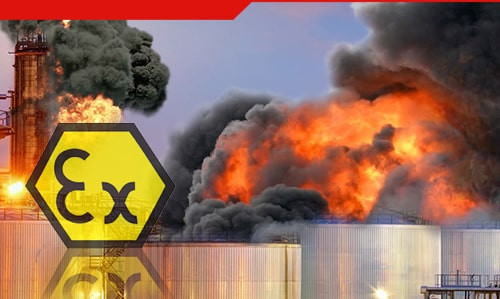
Explosion and explosion hazard zone.Read moreThe accepted definition of an explosion is that it occurs when a mixture of a flammable substance in the form of a gas, vapor, mist, or dust with air (or another oxidizer) – under atmospheric conditions and in the presence of an effective ignition source – ignites, and combustion spreads throughout the unburned mixture.
-
 07/11/2025
(Preventive) Explosion Protection MeasuresRead more
07/11/2025
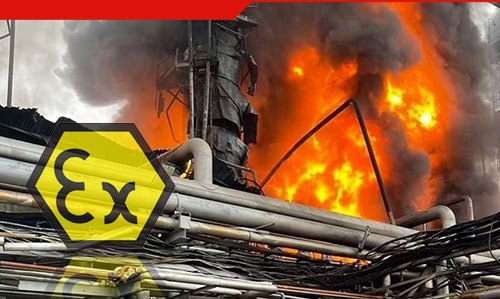
(Preventive) Explosion Protection MeasuresRead moreThe article describes the principles of secondary explosion protection — actions taken when it is not possible to completely avoid the formation of explosive atmospheres or ignition sources. The purpose of these measures is to limit the effects of an explosion to a level that is safe for people, installations, and the environment.
-
 07/11/2025
Sources of Ignition Covered by the ATEX DirectiveRead more
07/11/2025
Sources of Ignition Covered by the ATEX DirectiveRead moreThe article discusses one of the key issues in explosion protection – sources of ignition, which constitute one of the three main elements of explosion risk (alongside combustible substances and oxidizers). It highlights that without sufficient ignition energy, an explosion cannot occur; therefore, eliminating or minimizing ignition sources is a fundamental preventive measure.
-
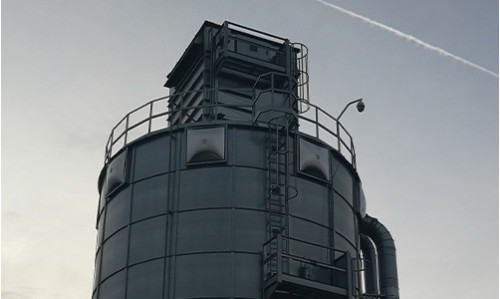 22/03/2023
Explosion venting in hazardous areasRead more
22/03/2023
Explosion venting in hazardous areasRead moreActions taken to eliminate or reduce the risk of explosion should lead to the complete removal of the risk of explosion. In reality, however, it often happens that it is not possible to get rid of the explosive atmosphere, because these are the conditions of the processes being carried out or it would require huge financial outlays.
-
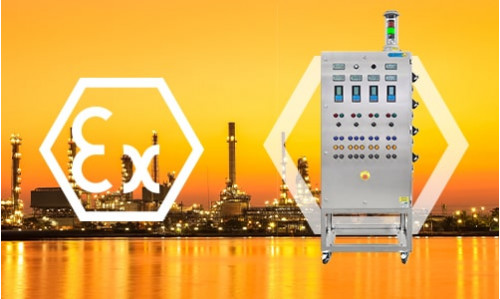 07/10/2022
EX s – higher level of pressurized protectionRead more
07/10/2022
EX s – higher level of pressurized protectionRead moreThe difference between the EX p and EX s systems is primarily the need for ventilation, which while in the former is a necessity, in the latter it is optionally activated after the analysis of the presence of flammable gas inside the housing. In both cases, it is necessary to have a gas sensor adapted to the currently present flammable / explosive substance in the installation and its calibration once a year.
-
 19/05/2022
Hazardous areas & explosive atmospheres - basic principlesRead more
19/05/2022
Hazardous areas & explosive atmospheres - basic principlesRead moreThe subject of explosion protection is described by a specific set of terms and definitions that have been permanently included in the process safety dictionary. Based on EU directives, standards and relevant regulations, a list of terms that are commonly used to characterize hazards in Ex zones has been created. The list is interdisciplinary and reflects the complexity of the proces safety issue.
-
 29/03/2022
Stosowanie iskrobezpieczeństwa jako działanie prewencyjneRead more
29/03/2022
Stosowanie iskrobezpieczeństwa jako działanie prewencyjneRead moreSystemy iskrobezpieczne, zdefiniowane jako zestaw połączonych ze sobą urządzeń elektrycznych, w którym obwody lub części obwodów przeznaczonych do użytku w atmosferze wybuchowej są obwodami iskrobezpiecznymi, zanim zostaną zainstalowane na konkretnym obiekcie muszą być prawidłowo zaprojektowane i ocenione jako bezpieczne.
-
 29/03/2022
Promieniowanie optyczne - jak się przed nim chronić?Read more
29/03/2022
Promieniowanie optyczne - jak się przed nim chronić?Read moreJednym z rodzajów efektywnych źródeł zapłonu, które zostało wymienione w normie „Atmosfery wybuchowe – zapobieganie wybuchowi i ochrona przed wybuchem” jest promieniowanie optyczne. Z punktu widzenia fizyki jest to oddziaływanie podlegające prawom optyki geometrycznej i falowej, a od strony bezpieczeństwa procesowego jeden z czynników, które w odpowiednich warunkach mogą doprowadzić do poważnej awarii przemysłowej.
-
 29/03/2022
Ochrona ciśnieniowa Ex p w pigułceRead more
29/03/2022
Ochrona ciśnieniowa Ex p w pigułceRead moreEX p jest to metoda ochrony polegająca na umieszczeniu podzespołów, które w czasie swojej normalnej pracy mogą wywołać iskrę lub nagrzewać się, w zamkniętej i szczelnej obudowie wypełnionej powietrzem lub innym gazem niepalnym pozostającym pod stałym ciśnieniem.
-
 29/03/2022
Metoda ochrony Ex d (ognioszczelność) - czym się charakteryzuje?Read more
29/03/2022
Metoda ochrony Ex d (ognioszczelność) - czym się charakteryzuje?Read moreOsłona ognioszczelna może być stosowana do większości urządzeń elektrycznych jak silniki elektrycznej, puszki łączeniowe, skrzynki rozdzielcze, łączniki, osprzęt instalacyjny czy oprawy oświetleniowe. W przypadku pierwszego z wymienionych rodzajów urządzeń, skrzynki zaciskowe silników elektrycznych w wykonaniu ognioszczelnym również powinny być ognioszczelne.
-
 02/11/2021
Strefa zagrożenia wybuchem gazuRead more
02/11/2021
Strefa zagrożenia wybuchem gazuRead morePrzy wyznaczaniu stref zagrożonych wybuchem dla gazu ziemnego bardzo ważne jest określenie w jakich warunkach może wystąpić zagrożenie wybuchem oraz jak, w przypadku potencjalnego wybuchu, zminimalizować jego skutki.
-
 25/10/2021
Warunki techniczne dla stref zagrożonych wybuchemRead more
25/10/2021
Warunki techniczne dla stref zagrożonych wybuchemRead moreKlasyfikacja ogniowa jest przede wszystkim pierwszym elementem, od którego zaczynamy dobór zabezpieczeń.
-
 12/10/2021
Iskrobezpieczeństwo w obszarze ExRead more
12/10/2021
Iskrobezpieczeństwo w obszarze ExRead moreOchronę obwodów iskrobezpiecznych od innych obwodów elektrycznych zapewnia się przez oddzielenie obwodów iskrobezpiecznych od innych obwodów poprzez zastosowanie ochrony obwodów iskrobezpiecznych
-
 10/10/2021
EX zones - requirements, regulations, standardsRead more
10/10/2021
EX zones - requirements, regulations, standardsRead moreZe względu na fakt, że substancji potencjalnie wybuchowych jest stosunkowo dużo to urządzenia – w szczególności elektryczne – które są przeznaczone do pracy w takich warunkach podlegają określonym wymaganiom
-
 22/07/2021
Ochrona przed wybuchemRead more
22/07/2021
Ochrona przed wybuchemRead moreOchrona przeciwwybuchowa jest problemem szczególnie ważnym dla bezpieczeństwa; wybuchy narażają życie i zdrowie pracowników w wyniku niekontrolowanego działania ognia i ciśnienia, występowania produktów wywołujących szkodliwe reakcje i pochłaniania tlenu w powietrzu, którym oddychają pracownicy
Showing 1 to 17 of 17 (1 Page)