Ex Components - EX Explosion Hazard Zones
DACPOL Sp. z o.o. has been engaged in sales, manufacturing, consulting, and service activities for over 27 years.
We specialize in comprehensive supply of components for: POWER ELECTRONICS, ELECTRONICS, INDUSTRIAL AUTOMATION, ELECTRONICS, ENERGY, and EX ZONES.
We also design and manufacture power units, induction heating, and manufacture and service industrial measurement devices.
We consistently implement a comprehensive customer service strategy through a wide range of products, the knowledge and experience of our engineers, and efficient logistics. We closely monitor the development of new technologies, striving to ensure access to market innovations.
DACPOL has expanded its product solutions designed for use in potentially explosive atmospheres, such as zones 0, 1, or 2 for gases, and zones 20, 21, or 22 for dust.
Our Ex product range includes equipment compliant with the ATEX Directive 2014/34/EU. The technical team will help you choose the right solutions for your individual needs.
The EX Department primarily deals with:
EX Electrical Engineering
- Exe/Exi/Exd junction boxes
- Exe/Exd control panels
- Overpressure systems
- Lighting
- Cable entries and bushings
- Grounding
EX Automation
- Visualization, control, and monitoring
- Physical measurement
- IT systems
- Access control
- Signaling
Heating systems and connectors EX
- heating cables
- various types of connections
The EX PRODUCTS catalog includes selected products that are regularly available. Thanks to our experience, we offer professional assistance and advice in selecting the optimal solution.
We offer products designed for use in diverse environments where explosive atmospheres can be generated in zones 0, 1, or 2 for gases, as well as zones 20, 21, or 22 for dust. In our catalog, you will find equipment compliant with the ATEX Directive 2014/34/EU (ATEX 114).
EX Explosion Hazard Zone
GAS EXPLOSION HAZARD ZONE – an area in which a mixture of flammable substances with air or other oxidizing gases may occur, with a concentration between the lower and upper explosion limits. Explosion hazard zones are workplaces where explosive atmospheres may occur. They are classified according to the division into explosion hazard zones, in accordance with § 5.1 of the Regulation of the Minister of Economy of July 8, 2010. "On the minimum requirements for occupational health and safety related to the possibility of an explosive atmosphere occurring in the workplace" (Journal of Laws of 2010, No. 138, item 931).
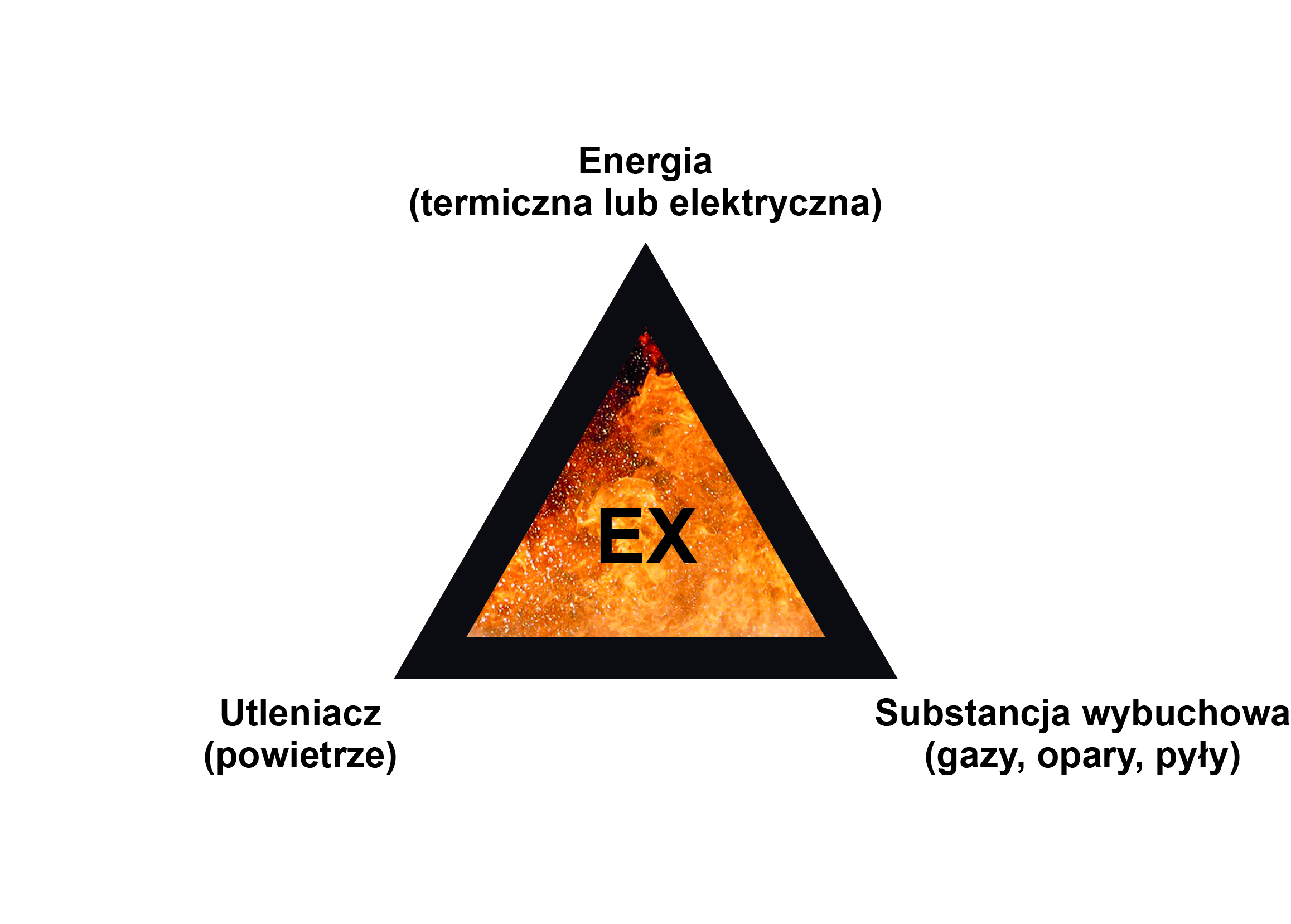
Properties of a flammable substance-air mixture
Flammable properties
- Flash point
- Lower explosive limit (LEL) is the lowest fuel concentration in a flammable mixture below which ignition of the mixture under the influence of an initiating factor and further spontaneous flame propagation under specific test conditions are not possible.
- Upper explosive limit (UEL) is the highest fuel concentration in a flammable mixture. flammable mixture, above which ignition of the mixture under the influence of an initiating factor and subsequent spontaneous flame propagation under specific test conditions are not possible,
| Gas |
% gas in air |
| DGW |
GGW |
| Hydrogen |
4.1 |
74.2 |
| Carbon monoxide |
12.5 |
74.2 |
| Methane |
5.3 |
14 |
| Ethane |
3,2 |
12.5 |
| Propane |
2.4 |
9.5 |
| Butane |
1.9
8.4 |
| Acetylene |
2.5 |
80 |
| Gas |
5,6 |
31 |
| Water gas |
6.2 |
72 |
| Natural Gas |
4.5 |
17 |
| City gas |
32 |
74 |

Autoignition temperature is the lowest temperature at which a flammable substance ignites upon contact with a hot surface or as a result of thermal radiation from that surface (without the participation of an external flame or spark). Gases and liquid vapors with an autoignition temperature below 85°C are considered autoignitable at room temperature.
Temperature table
| Autoignition temperature [°C] |
Temperature class |
Example substance |
| > 450 |
T1 |
Hydrogen, carbon monoxide, ammonia |
| > 300 - 450 |
T2 |
Acetylene, n-butane, ethylene oxide |
| > 200 - 300 |
T3 |
N-octane, turpentine, acrolein |
| > 135 - 200 |
T4 |
Acetaldehyde, diethyl ether |
| > 100 - 135 |
T5 |
Carbon disulfide |
| > 85 - 100 |
T6 |
Phosphine |
Device breakdown
| Group I: |
Methane in underground mine workings |
| Group II: |
Gas, mists, vapors
IIA – propane group (260 µJ)
(122 gases and vapors, e.g., acetone, methyl and ethyl alcohol)
IIB – ethylene group (95 µJ)
(27 gases and vapors, e.g., ethylene, hydrogen sulfide)
IIC – hydrogen group (18 µJ)
/> (4 gases: acetylene, hydrogen, hydrazine, carbon disulfide) |
| Group III: |
dust and other
IIIA – explosive flocs
IIIB – non-conductive dust
IIIC – conductive dust |
Ignition sources
Primary ignition sources may be:
- Mechanically generated sparks
- Electrical sparks
- Electrostatic sparks
- Hot surfaces
- Flames
- Ionizing radiation
- Shock waves
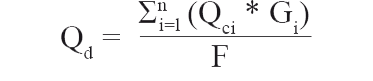
| Fire load density |
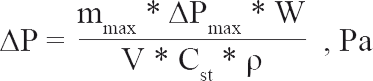
Increase in pressure in a room caused by an explosion
involving flammable gases or vapors |
 |
 |
| n |
– number of types of flammable materials present in the room, fire zone, or storage area, |
| Gi |
– mass of individual materials [kg], |
| Qci |
– heat of combustion of individual materials [MJ/kg], |
| F |
– horizontal projection area of the room, fire compartment, or storage area [m2]. |
|
| mmax |
– maximum mass of flammable substances forming an explosive mixture that can be released in the considered space [kg], |
| ΔPmax |
– maximum pressure increase during the explosion of a stoichiometric gas or steam-air mixture in a closed chamber [Pa], |
| W |
– coefficient of the explosion reaction, taking into account the non-airtightness of the room, the non-adiabatic nature of the explosion reaction, and the fact that less than the entire amount of flammable gases and vapors that would be released in the room were involved in the reaction – equal to 0.17 for flammable gases and 0.1 for flammable vapors, |
| V |
– volume of the room's airspace, being the difference between the volume of the room and the volume of the installations, equipment, closed packages, etc. contained within it [m3], |
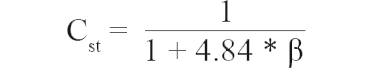
| Cst |
– volumetric stoichiometric concentration of flammable gases or vapors: |
 |
| β |
– stoichiometric coefficient of oxygen in the explosion reaction: |
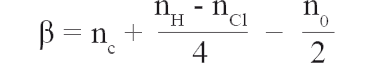 |
| nC, nH, nCl, nO |
– the numbers of carbon, hydrogen, halogen, and oxygen atoms in a gas or vapor molecule, respectively. |
| ρ |
– density of flammable gases or vapors at room temperature under normal operating conditions [kg/m3]. |
|
EX Classification
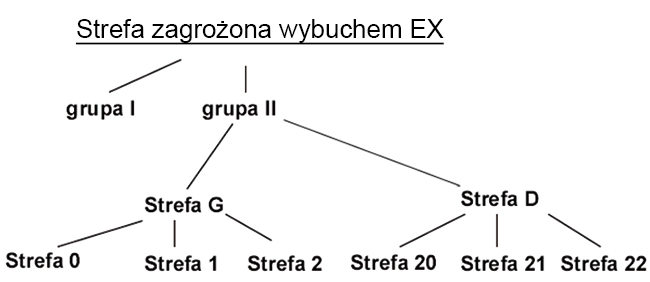
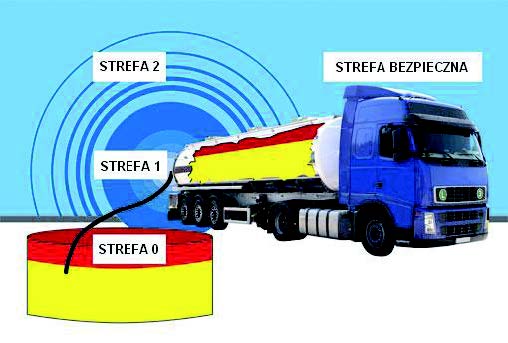
Zone G – gases, mists, vapors
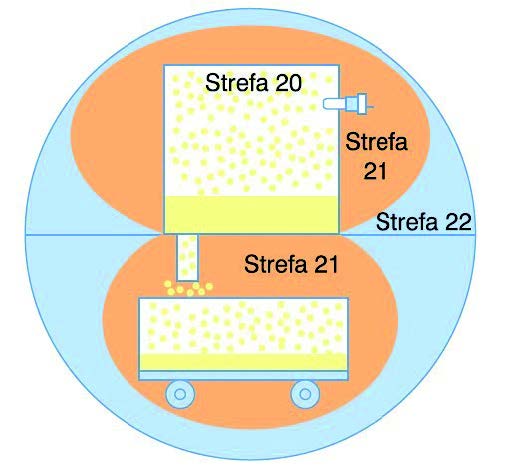
Zone D – dust
Zone 0 – an explosive atmosphere occurs continuously and persists for a long time
Zone 1 – an explosive atmosphere occurs sporadically
Zone 2 – an explosive atmosphere does not occur during normal operation, and if it does occur, it persists for a short time.
Equipment Safety Categories according to Directive 94/9/EC
EQUIPMENT CATEGORY 1 – these devices provide a very high level of safety and allow for continuous operation where an explosive atmosphere is constantly present => zone "0"
EQUIPMENT CATEGORY 2 – these devices provide a high level of protection => Zone "1"
CATEGORY 3 DEVICES – these devices provide a normal level of protection => Zone "2"
| Explosion hazard zone |
Explosion hazard zone |
Device category |
| 0 |
20 |
1 |
| 1 |
21 |
2 |
| 2 |
22 |
3 |
Protection methods
| Protection type for zones 0+1+2 |
| Protection type |
Standard |
Description |
Zone |
| EX d |
60079-1 |
Flameproof construction |
1 and 2 |
| EX p |
60079-2 |
Positive pressure gas shield |
1 and 2 |
| EX q |
60079-5 |
Sand cover |
1 and 2 |
| EX o |
60079-6 |
Oil cover |
1 and 2 |
| EX e |
60079-7 |
Reinforced structure |
1 and 2 |
| EX i |
60079-11 |
Intrinsically safe |
0, 1 and 2 |
| EX n |
60079-15 |
Construction of "EX n" devices |
2 |
| EX m |
60079-18 |
Device encapsulated with 'm' insulating mass |
1 and 2 |
| Protection type for zones 0+1+2 |
| EX tD |
61241-1 |
Protection by enclosure |
21 and 22 |
| EX pD |
61241-4 |
Protection under pressure |
21 and 22 |
| EX iD |
61241-11 |
Intrinsically safe |
20, 21 and 22 |
| EX m.D |
61241-18 |
Device encapsulated with 'm' insulating mass |
20, 21 and 22 |