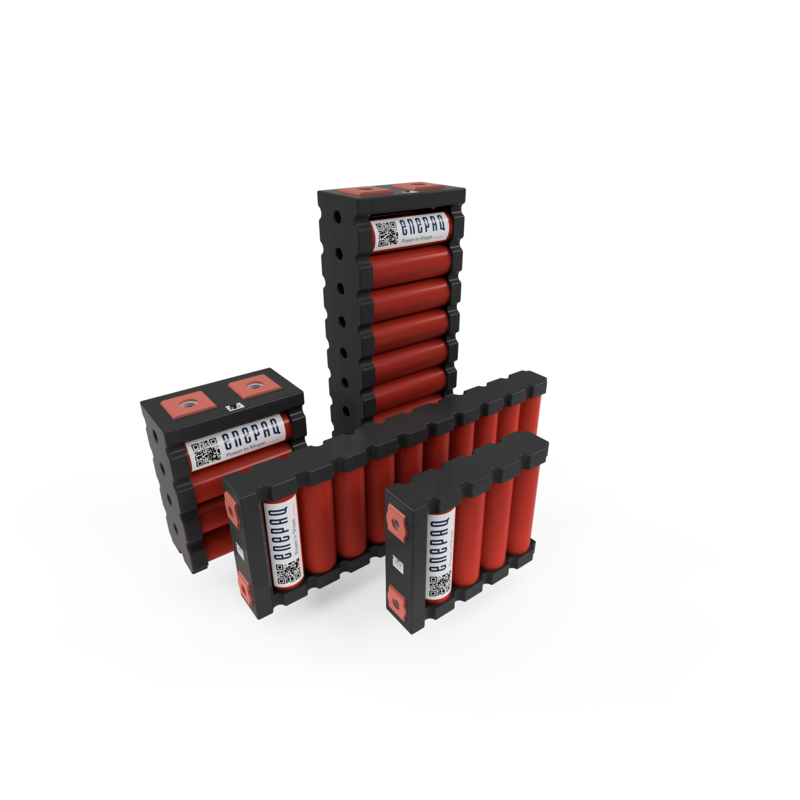
LG HG2 Li-ion Battery Module
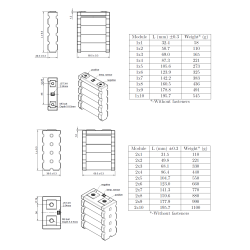
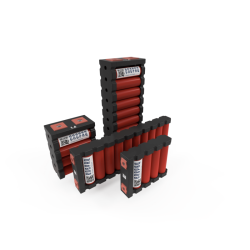
Battery module from 1s1p to 1s20p with 18650 size cells.
- Small size: 236-411 Wh per liter
- Light weight: 186-196 Wh per kg
- Cells with individual overvoltage protection
- Ultra-low and even self-discharge
- Rapid battery pack prototyping
- Convenient thermal control
- Built-in temperature sensors
- UL94-V0 rated, flame-retardant plastics
- Certified UN38.3
NOTE: If you select a Li2x battery module..., this means that the number of parallel battery cells will be multiplied by two.
The Enepaq battery module combines the best of two worlds - low weight, high power, quality, safety, and ease of use.
Enepaq battery modules are a unique combination of the latest battery technology, safety, and ease of use. Each battery module consists of several 3.6V Li-ion 18650 cells connected in parallel. Several such blocks can be connected in parallel and series to create high-voltage batteries of various shapes and sizes.
While a roll mill may seem like an inefficient use of space at first glance, the internal conductors are very tightly wound and often offer higher energy density per unit volume and weight than the competition, even for the entire stack, taking into account air gaps between the rolls. The absence of the need for compression plates provides another opportunity for space and weight savings. The resulting air gaps also offer the potential for easy and effective thermal management, both liquid and air.
SAFETY
The 18650s are housed in a self-contained metal case that does not require special handling, such as mechanical compression used for pocket cells, or swelling compensation used for pocket and prismatic cells, which complicate the overall design and construction of the battery pack.
Each cell is also equipped with a bimetallic fuse and pressure release valve to manage critical events such as short circuits or mechanical damage, in addition to the already robust metal case.
In addition to the internal protection techniques, the module includes two fuses for each cell. These are a second level of protection in the event of a cell failure. When a cell is vented, the released gas flows through dedicated channels to prevent pressure buildup.
QUALITY
Due to their long history and well-established manufacturing techniques, these cells offer very high quality and an almost unbelievably low failure rate of only 0.01 per million, which becomes crucial when a battery consists of thousands of cells.
A stable manufacturing process leads to high tolerances and low performance drift. Cells typically measure less than 3 mV of voltage difference even after years of storage, meaning very little maintenance and balancing is required. This allows for the use of cost-effective and reliable battery management systems with low balancing currents: 5 mA of drain per 200 Ah pack is often acceptable. It also means that all battery modules manufactured by us are in perfect balance upon delivery. In contrast, initial balancing of low-quality cells can take weeks or even months, typically requiring special equipment for initial battery pack conditioning.
FLEXIBILITY
Due to the simple nature of these building blocks, the desired battery pack configuration can be built in minutes by connecting them in series and parallel using bolted connections. Even MWh-scale batteries can be easily assembled.
Each battery module comes with a variety of options:
- Single row or double row
- Up to 10 cells per row
- Optional multi-point temperature sensor
- Various 18650 cell models
APPLICATIONS
- Formula SAE student electric car
- Electric performance vehicles
- Autonomous robotics
- Electric bicycles
- Electric bikes
- Scooters Electric
- Specialized Machinery
- Golf Carts
- Go Karts
- Backup Energy Storage
The Li-Ion battery module was developed with simplicity and safety in mind. Utilizing 18650 lithium-ion technology, these battery modules offer the most modern and energy-efficient solution in an easy-to-use package. 18650 is a very well-established and proven battery cell standard, particularly common in consumer devices. These cells are designed to withstand consumer abuse while offering best-in-class energy density.
The cylindrical form factor is arguably the best solution for Li-Ion battery cells available today, offering unmatched quality, safety, and the latest advancements in battery technology. However, these cells have several drawbacks related to their shape and small size: the cylindrical shape requires special trays, the non-sealed contacts require complex rail welding techniques, and the small size is very labor-intensive when building a large battery pack with thousands of cells.
Furthermore, there are numerous safety issues that require attention and usually need to be addressed by highly skilled engineers with many years of experience in the field. While all of this can be managed by large automotive companies, smaller companies are usually overwhelmed by these challenges and opt for other solutions, such as pocket cells and prismatic cells. Even large automotive companies don't always achieve immediate success, or they often look for easier options. For these reasons, very few electric car models use cylindrical battery cells, despite their clear advantages.