RS232-RS422/RS485 converter - 485PTBR

Photos are for informational purposes only. View product specification

please use latin characters

Manufacturer: B&B Electronics

RS232-RS422/RS485 converter - 485PTBR

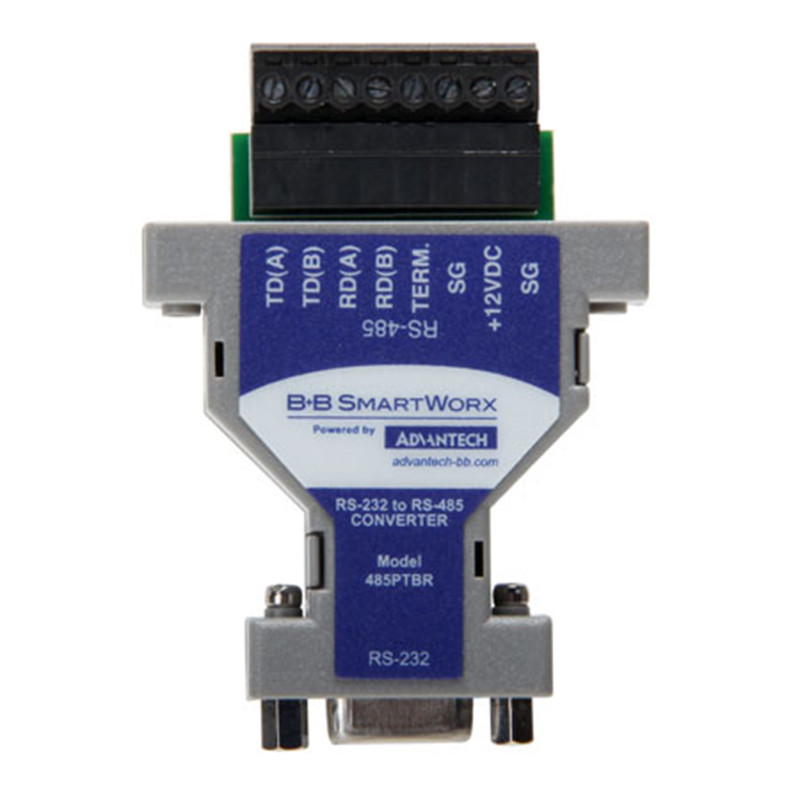
The 485PTBR converts unbalanced full-duplex RS-232 signals to balanced full-duplex or half-duplex RS-485 signals. RS-485 is an extended version of the RS-422 standard. It allows for the use of multiple drivers and receivers in a two-wire system. The RS-232 port has a female DB-9 connector supporting pins 2 (RD), 3 (TD), and 5 (SG). Pins 7 (RTS) and 8 (CTS) are connected together. Pins 6 (DSR), 1 (CD), and 4 (DTR) are also connected, but do not pass through the converter. The RS-485 port has an 8-position plug-in connector.

Baud Rate


The 485PTBR can transmit data at rates from 300 baud to 115.2 KBd. To change the baud rate of the 485PTBR, it is necessary to replace a resistor and, in some cases, a capacitor. The resistor and capacitor parameters can be determined by locating the desired baud rate in Table 1. Remove R3 and C7 from the circuit board. Place the new components in positions R2 and C6. The locations of the resistor and capacitor are shown in Figures 1 and 2.


Biasing Resistors


You can also change the biasing resistors R5 and R7. The 485PTBR device is equipped with standard 4.7K biasing resistors. To change the parameters of the biasing resistors, remove R5 and R7 and replace them with resistors with different parameters in places R4 and R6. The resistor locations are shown in Figures 1 and 2.


Burning Resistors


In the 485PTBR device, the load resistor is located in position R8. The load resistor can be placed in position R8 and a jumper connected to RD(B). The recommended load resistor resistance is 100 to 120 ohms. The location of the load resistors is shown in Figure 2.


Activating Continuous Receive


In the standard 485PTBR configuration, the receiver is disabled during transmission. The 485PTBR can be configured to enable continuous receive. By removing R9, the receiver operates in continuous receive (four-wire) mode. When R9 is part of the circuit, the 485PTBR operates in half-duplex (two-wire) mode. The jumper locations are shown in Figure 1.


Data Line Polarity


The polarity of the two RS-485 lines must be correct. When no data is being transmitted, the RS-232 line should be negative and the RS-485 "A" pin should be negative with respect to the "B" pin. If the equipment being installed uses the "+" and "-" marking scheme, in most cases the "A" line will be connected to "-" and the "B" line to "+".

DECLARATION OF CONFORMITY
Manufacturer's name: B[&]B Electronics Manufacturing Company
Manufacturer's address: P.O. Box 1040
707 Dayton Road
Ottawa, IL 61350 USA
Model Number: 485PTBR
Description: RS-232 to RS-485 Converter
Type: Light Industrial ITE Equipment
Applicable Council Directives: 89/336/EEC
Standards: EN 55022
EN 61000-6-1
EN 61000 (-4-2, -4-3, -4-4, -4-5, -4-6, -4-8, -4-11)

Table 1
REPLACEABLE COMPONENTS FOR CHANGING THE WAIT TIME FOR TRANSMISSION RATE
Transmission Speed Time (ms) Resistor (R3) (ohm) Capacitor (C7) (mF)
300 33.3 330K 0.1
600 16.6 160K 0.1
1200 8.33 820K 0.01
2400 4.16 430K 0.01
4800 2.08 200K 0.01
9600 1.04 100K 0.01
19200 0.52 56K 0.01
38400 0.26 27K 0.01
57600 0.176 16K 0.01
115200 0.0868 8.2K 0.01
RS-232 to RS-485 converter

Figure 1. PC Board Layout - Bottom


Figure 2. PC Board Layout - Bottom
DB9S FEMALE CONNECTOR MODEL 485PTBR PLUG-IN CONNECTOR
WITH TERMINAL BLOCK

* R2 AND C6 SHOULD BE USED ​​FOR BAUD RATES OTHER THAN 9600 BADGE. IT MAY BE NECESSARY TO REMOVE R3 AND C7. SEE TABLE 1 FOR VALUE CHANGES.
** OPTIONAL LOAD RESISTOR R8. RD(B) AND THE LOAD CAN BE JUMPERED TO ENABLE THE LOAD.
*** RESISTORS R4 AND R6 ALLOW POLARITY CHANGES IN THE OFF STATE. IT MAY BE NECESSARY TO REMOVE R5 AND R7.
NOTE: 0-OHM RESISTOR R9 MUST BE REMOVED TO ENABLE CONTINUOUS RECEPTION. R9 CAN BE RE-SOLDERED IN ITS PLACE TO DISABLE THE RECEIVER DURING DATA TRANSMISSION.

Send an inquiry

Are you interested in this product? Do you need additional information or individual pricing?

Contact us
ASK FOR THE PRODUCT close
Thank you for sending your message. We will respond as soon as possible.
ASK FOR THE PRODUCT close
Browse

Add to Wishlist

You must be logged in

The 485PTBR converts unbalanced full-duplex RS-232 signals to balanced full-duplex or half-duplex RS-485 signals. RS-485 is an extended version of the RS-422 standard. It allows for the use of multiple drivers and receivers in a two-wire system. The RS-232 port has a female DB-9 connector supporting pins 2 (RD), 3 (TD), and 5 (SG). Pins 7 (RTS) and 8 (CTS) are connected together. Pins 6 (DSR), 1 (CD), and 4 (DTR) are also connected, but do not pass through the converter. The RS-485 port has an 8-position plug-in connector.

Baud Rate


The 485PTBR can transmit data at rates from 300 baud to 115.2 KBd. To change the baud rate of the 485PTBR, it is necessary to replace a resistor and, in some cases, a capacitor. The resistor and capacitor parameters can be determined by locating the desired baud rate in Table 1. Remove R3 and C7 from the circuit board. Place the new components in positions R2 and C6. The locations of the resistor and capacitor are shown in Figures 1 and 2.


Biasing Resistors


You can also change the biasing resistors R5 and R7. The 485PTBR device is equipped with standard 4.7K biasing resistors. To change the parameters of the biasing resistors, remove R5 and R7 and replace them with resistors with different parameters in places R4 and R6. The resistor locations are shown in Figures 1 and 2.


Burning Resistors


In the 485PTBR device, the load resistor is located in position R8. The load resistor can be placed in position R8 and a jumper connected to RD(B). The recommended load resistor resistance is 100 to 120 ohms. The location of the load resistors is shown in Figure 2.


Activating Continuous Receive


In the standard 485PTBR configuration, the receiver is disabled during transmission. The 485PTBR can be configured to enable continuous receive. By removing R9, the receiver operates in continuous receive (four-wire) mode. When R9 is part of the circuit, the 485PTBR operates in half-duplex (two-wire) mode. The jumper locations are shown in Figure 1.


Data Line Polarity


The polarity of the two RS-485 lines must be correct. When no data is being transmitted, the RS-232 line should be negative and the RS-485 "A" pin should be negative with respect to the "B" pin. If the equipment being installed uses the "+" and "-" marking scheme, in most cases the "A" line will be connected to "-" and the "B" line to "+".

DECLARATION OF CONFORMITY
Manufacturer's name: B[&]B Electronics Manufacturing Company
Manufacturer's address: P.O. Box 1040
707 Dayton Road
Ottawa, IL 61350 USA
Model Number: 485PTBR
Description: RS-232 to RS-485 Converter
Type: Light Industrial ITE Equipment
Applicable Council Directives: 89/336/EEC
Standards: EN 55022
EN 61000-6-1
EN 61000 (-4-2, -4-3, -4-4, -4-5, -4-6, -4-8, -4-11)

Table 1
REPLACEABLE COMPONENTS FOR CHANGING THE WAIT TIME FOR TRANSMISSION RATE
Transmission Speed Time (ms) Resistor (R3) (ohm) Capacitor (C7) (mF)
300 33.3 330K 0.1
600 16.6 160K 0.1
1200 8.33 820K 0.01
2400 4.16 430K 0.01
4800 2.08 200K 0.01
9600 1.04 100K 0.01
19200 0.52 56K 0.01
38400 0.26 27K 0.01
57600 0.176 16K 0.01
115200 0.0868 8.2K 0.01
RS-232 to RS-485 converter

Figure 1. PC Board Layout - Bottom


Figure 2. PC Board Layout - Bottom
DB9S FEMALE CONNECTOR MODEL 485PTBR PLUG-IN CONNECTOR
WITH TERMINAL BLOCK

* R2 AND C6 SHOULD BE USED ​​FOR BAUD RATES OTHER THAN 9600 BADGE. IT MAY BE NECESSARY TO REMOVE R3 AND C7. SEE TABLE 1 FOR VALUE CHANGES.
** OPTIONAL LOAD RESISTOR R8. RD(B) AND THE LOAD CAN BE JUMPERED TO ENABLE THE LOAD.
*** RESISTORS R4 AND R6 ALLOW POLARITY CHANGES IN THE OFF STATE. IT MAY BE NECESSARY TO REMOVE R5 AND R7.
NOTE: 0-OHM RESISTOR R9 MUST BE REMOVED TO ENABLE CONTINUOUS RECEPTION. R9 CAN BE RE-SOLDERED IN ITS PLACE TO DISABLE THE RECEIVER DURING DATA TRANSMISSION.
Comments (0)