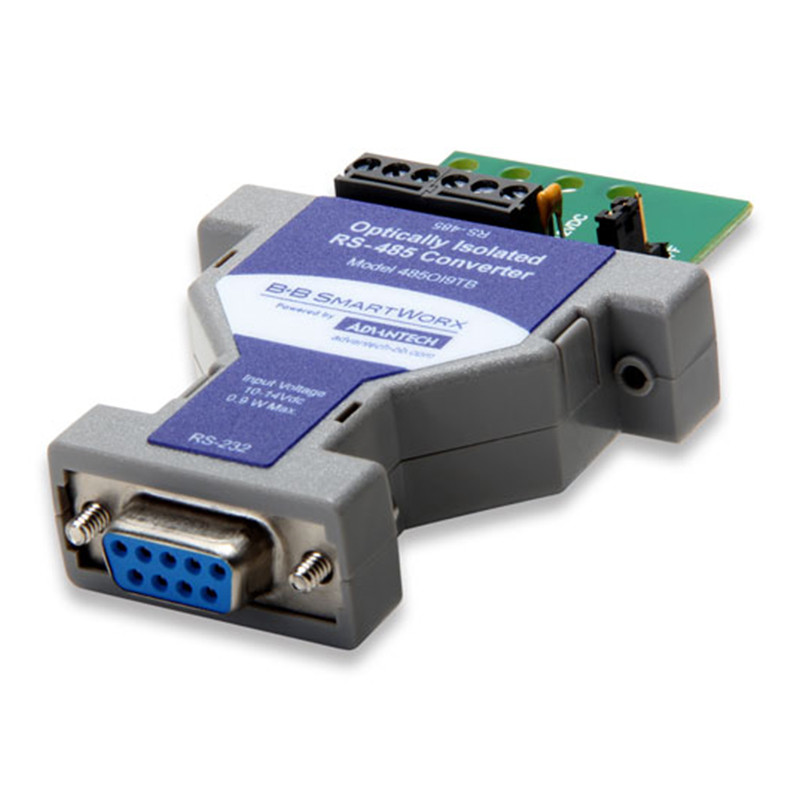
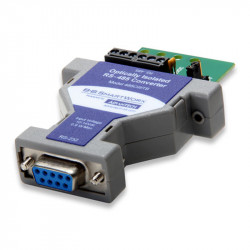
RS232-RS422/RS485 converter - optoinsulation - 485019TB

Photos are for informational purposes only. View product specification

please use latin characters

Manufacturer: B&B Electronics

RS232-RS422/RS485 converter - optoinsulation - 485019TB

The 485019TB converts unbalanced full-duplex RS-232 signals to balanced full-duplex (4-wire) or half-duplex (2-wire) RS-485 signals. It also provides 1500 volts RMS optical isolation (for 1 minute) on the data line and ground between RS-232 and RS-422/485 equipment.

The RS-232 port has a female DB9S connector supporting pins 3 (TD input) and 2 (RD output). Signal ground (pin 5) also passes through it. The RS-485 port has a 6-position connector labeled transmit data outputs (TD) and receive data inputs (RD). The RS-232 side of the converter draws power from the DTR (Digital Transmit Transmission Ready) line (pin 4) and the RTS (Request to Transmit Transmission Request) line (pin 7). One or the other must be used to power the device, but it is recommended to use both. Most software handles these handshake lines automatically, but they should be tested to be absolutely certain.

Figure 1
Figure 2

The Rt resistors are optional, depending on the line length, transfer rate, etc. For further information on load resistors, see the B[&]B Electronics Note on RS-422/RS-485 Applications. No special software is required, as the RS-485 driver is activated by the first transmission on the RS-232 side of the data line (Pin 3). Any transmission on the TD data line keeps the RS-485 driver active by preventing the monostable flip-flop from completing its wait period. The transmitter deactivates approximately 1 ms after the last transmitted character. Do not change this 1 ms wait period for data rates of 9600 baud or higher. If a different wait time is necessary, refer to Table 1. The 4850I9TB can communicate at rates up to 115.2K baud.

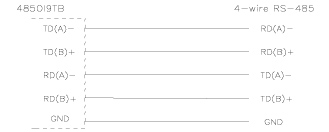
The echo jumper in the "on" position configures the 4850I9TB for operation with RS-422 or RS-485 in four-wire mode (see Figure 1). The echo jumper in the "off" position configures the 485OI9TB for operation with RS-422 or RS-485 in two-wire mode (see Figure 2). A single RS-485 controller can support up to 32 receivers, enabling the construction of large systems with multiple endpoints. If terminating resistors are used, they should be placed at opposite ends of the system.


Table 1

REPLACEABLE COMPONENTS FOR CHANGING THE WAIT TIME FOR THE TRANSMISSION RATE
Transmission rate. Time (ms). Resistor (R12) (ohm). Capacitor (C7) (mF).
300 33.3 330K 0 1
600 16.6 160K 0 1
1200 8.33 820K 0.01
2400 4.16 430K 0.01
4800 2.08 200K 0.01
9600 1.04 100K 0.01
19200 0.52 56K 0.01
38400 0.26 27K 0.01
57600 0.176 16K 0.01
115200 0.0868 8.2K 0.01

The RS-485 standard does not specify a cable type or maximum line length. However, the very similar RS-422 standard recommends the use of 24 AWG twisted-pair telephone cable with an electrical shunt capacitance of 16 picofarads per foot for distances not exceeding 1200 meters [4000 feet]. The polarity of the two RS-485 lines must be correct. When no data is being transmitted, the RS-232 line should be negative and the RS-485 "A" pin should be negative with respect to the "B" pin. If the equipment being installed uses the "+" and "-" marking scheme, in most cases the "A" line will be connected to the "-" and the "B" line to the "+".

CE DECLARATION OF CONFORMITY
Manufacturer's Name: B&B Electronics Manufacturing Company
Manufacturer's Address: P.O. Box 1040
707 Dayton Road
Ottawa, IL 61350 USA
Model Numbers: 4850I9TB
Description: Optically Isolated RS-232 to RS-422/485 Converter
Type: Light Industrial Equipment Class ITE
Applicable Council Directives: 89/336/EEC
Standards: EN 55022
EN 61000-6-1
EN 61000 (-4-2, -4-3, -4-4, -4-5, -4-6, -4-8, -4-11)

Send an inquiry

Are you interested in this product? Do you need additional information or individual pricing?

Contact us
ASK FOR THE PRODUCT close
Thank you for sending your message. We will respond as soon as possible.
ASK FOR THE PRODUCT close
Browse

Add to Wishlist

You must be logged in

The 485019TB converts unbalanced full-duplex RS-232 signals to balanced full-duplex (4-wire) or half-duplex (2-wire) RS-485 signals. It also provides 1500 volts RMS optical isolation (for 1 minute) on the data line and ground between RS-232 and RS-422/485 equipment.

The RS-232 port has a female DB9S connector supporting pins 3 (TD input) and 2 (RD output). Signal ground (pin 5) also passes through it. The RS-485 port has a 6-position connector labeled transmit data outputs (TD) and receive data inputs (RD). The RS-232 side of the converter draws power from the DTR (Digital Transmit Transmission Ready) line (pin 4) and the RTS (Request to Transmit Transmission Request) line (pin 7). One or the other must be used to power the device, but it is recommended to use both. Most software handles these handshake lines automatically, but they should be tested to be absolutely certain.

Figure 1
Figure 2

The Rt resistors are optional, depending on the line length, transfer rate, etc. For further information on load resistors, see the B[&]B Electronics Note on RS-422/RS-485 Applications. No special software is required, as the RS-485 driver is activated by the first transmission on the RS-232 side of the data line (Pin 3). Any transmission on the TD data line keeps the RS-485 driver active by preventing the monostable flip-flop from completing its wait period. The transmitter deactivates approximately 1 ms after the last transmitted character. Do not change this 1 ms wait period for data rates of 9600 baud or higher. If a different wait time is necessary, refer to Table 1. The 4850I9TB can communicate at rates up to 115.2K baud.

The echo jumper in the "on" position configures the 4850I9TB for operation with RS-422 or RS-485 in four-wire mode (see Figure 1). The echo jumper in the "off" position configures the 485OI9TB for operation with RS-422 or RS-485 in two-wire mode (see Figure 2). A single RS-485 controller can support up to 32 receivers, enabling the construction of large systems with multiple endpoints. If terminating resistors are used, they should be placed at opposite ends of the system.


Table 1

REPLACEABLE COMPONENTS FOR CHANGING THE WAIT TIME FOR THE TRANSMISSION RATE
Transmission rate. Time (ms). Resistor (R12) (ohm). Capacitor (C7) (mF).
300 33.3 330K 0 1
600 16.6 160K 0 1
1200 8.33 820K 0.01
2400 4.16 430K 0.01
4800 2.08 200K 0.01
9600 1.04 100K 0.01
19200 0.52 56K 0.01
38400 0.26 27K 0.01
57600 0.176 16K 0.01
115200 0.0868 8.2K 0.01

The RS-485 standard does not specify a cable type or maximum line length. However, the very similar RS-422 standard recommends the use of 24 AWG twisted-pair telephone cable with an electrical shunt capacitance of 16 picofarads per foot for distances not exceeding 1200 meters [4000 feet]. The polarity of the two RS-485 lines must be correct. When no data is being transmitted, the RS-232 line should be negative and the RS-485 "A" pin should be negative with respect to the "B" pin. If the equipment being installed uses the "+" and "-" marking scheme, in most cases the "A" line will be connected to the "-" and the "B" line to the "+".

CE DECLARATION OF CONFORMITY
Manufacturer's Name: B&B Electronics Manufacturing Company
Manufacturer's Address: P.O. Box 1040
707 Dayton Road
Ottawa, IL 61350 USA
Model Numbers: 4850I9TB
Description: Optically Isolated RS-232 to RS-422/485 Converter
Type: Light Industrial Equipment Class ITE
Applicable Council Directives: 89/336/EEC
Standards: EN 55022
EN 61000-6-1
EN 61000 (-4-2, -4-3, -4-4, -4-5, -4-6, -4-8, -4-11)

Comments (0)