
-
-
-
Category
-
Semiconductors
- Diodes
- Thyristors
-
Electro-insulated Modules
- Electro-insulated Modules | VISHAY (IR)
- Electro-insulated Modules | INFINEON (EUPEC)
- Electro-insulated Modules | Semikron
- Electro-insulated Modules | POWEREX
- Electro-insulated Modules | IXYS
- Electro-insulated Modules | POSEICO
- Electro-insulated Modules | ABB
- Electro-insulated Modules | TECHSEM
- Go to the subcategory
- Bridge Rectifiers
-
Transistors
- Transistors | GeneSiC
- SiC MOSFET Modules | Mitsubishi
- SiC MOSFET Modules | STARPOWER
- Module SiC MOSFET ABB’s
- IGBT Modules | MITSUBISHI
- Transistor Modules | MITSUBISHI
- MOSFET Modules | MITSUBISHI
- Transistor Modules | ABB
- IGBT Modules | POWEREX
- IGBT Modules | INFINEON (EUPEC)
- Silicon Carbide (SiC) semiconductor elements
- Go to the subcategory
- Gate Drivers
- Power Blocks
- Go to the subcategory
- Electrical Transducers
-
Passive components (capacitors, resistors, fuses, filters)
- Resistors
-
Fuses
- Miniature Fuses for electronic circuits - ABC & AGC Series
- Tubular Fast-acting Fuses
- Time-delay Fuse Links with GL/GG & AM characteristics
- Ultrafast Fuse Links
- Fast-acting Fuses (British & American standard)
- Fast-acting Fuses (European standard)
- Traction Fuses
- High-voltage Fuse Links
- Go to the subcategory
- Capacitors
- EMI Filters
- Supercapacitors
- Power surge protection
- TEMPEST emission revealing filters
- Surge arrester
- Go to the subcategory
-
Relays and Contactors
- Relays and Contactors - Theory
- 3-Phase AC Semiconductor Relays
- DC Semiconductor Relays
- Controllers, Control Systems and Accessories
- Soft Starters and Reversible Relays
- Electromechanical Relays
- Contactors
- Rotary Switches
-
Single-Phase AC Semiconductor Relays
- AC ONE PHASE RELAYS 1 series| D2425 | D2450
- One phase semiconductor AC relays CWA and CWD series
- One phase semiconductor AC relays CMRA and CMRD series
- One phase semiconductor AC relays - PS series
- Double and quadruple semiconductor AC relays - D24 D, TD24 Q, H12D48 D series
- One phase semiconductor relays - gn series
- Ckr series single phase solid state relays
- One phase AC semiconductor relays for DIN bus - ERDA I ERAA series
- 150A AC single phase relays
- Rail Mountable Solid State Relays With Integrated Heat Sink - ENDA, ERDA1 / ERAA1 series
- Go to the subcategory
- Single-Phase AC Semiconductor Relays for PCBs
- Interface Relays
- Go to the subcategory
- Cores and Other Inductive Components
- Heatsinks, Varistors, Thermal Protection
- Fans
- Air Conditioning, Accessories for Electrical Cabinets, Coolers
-
Batteries, Chargers, Buffer Power Supplies and Inverters
- Batteries, Chargers - Theoretical Description
- Modular Li-ion Battery Building Blocks, Custom Batteries, BMS
- Batteries
- Battery Chargers and Accessories
- Uninterruptible Power Supply and Buffer Power Supplies
- Inverters and Photovoltaic Equipments
- Energy storage
- Fuel cells
- Lithium-ion batteries
- Go to the subcategory
-
Automatics
- Spiralift Lifts
- Futaba Drone Parts
- Limit Switches, Microswitches
- Sensors, Transducers
-
Infrared Thermometers (Pyrometers)
- IR-TE Series - Water-proof Palm-sized Radiation Thermometer
- IR-TA Series - Handheld Type Radiation Thermometer
- IR-H Series - Handheld Type Radiation Thermometer
- IR-BA Series - High-speed Compact Radiation Thermometer
- IR-FA Series - Fiber Optic Radiation Thermometer
- IR-BZ Series - Compact Infrared Thermometers
- Go to the subcategory
- Counters, Time Relays, Panel Meters
- Industrial Protection Devices
- Light and Sound Signalling
- Thermographic Camera
- LED Displays
- Control Equipments
- Go to the subcategory
-
Cables, Litz wires, Conduits, Flexible connections
- Wires
- Cable feedthroughs and couplers
- Litz wires
-
Cables for extreme applications
- Extension and Compensation cables
- Thermocouple cables
- Connection cables for PT sensors
- Multi-conductor wires (temp. -60C to +1400C)
- Medium voltage cables
- Ignition wires
- Heating cables
- Single conductor cables (temp. -60C to +450C)
- Railway cables
- Heating cables Ex
- Cables for the defense industry
- Go to the subcategory
- Sleevings
-
Braids
- Flat Braids
- Round Braids
- Very Flexible Flat Braids
- Very Flexible Round Braids
- Cylindrical Cooper Braids
- Cylindrical Cooper Braids and Sleevings
- Flexible Earthing Connections
- PCV Insulated Copper Braids (temp. up to 85C)
- Flat Aluminium Braids
- Junction Set - Braids and Tubes
- Steel Braids
- Go to the subcategory
- Traction Equipment
- Cable Terminals
- Flexible Insulated Busbars
- Flexible Multilayer Busbars
- Cable Duct Systems
- Go to the subcategory
- View all categories
-
Semiconductors
-
-
Heatsink – what it is and how it works?

A heatsink is a component that plays a key role in electronic circuits and in the cooling systems of various devices. A heatsink is a device whose task is to dissipate heat from components generating large amounts of thermal energy, such as a processor, transistor, or other electronic components. The heatsink absorbs heat and then transfers it to the surrounding air or liquid. This helps prevent situations where electronic components could overheat and become damaged.
Heatsinks are usually made of materials with high thermal conductivity, such as aluminum or copper. This is why a heatsink is a key component in almost every electronic design – from small circuits to large industrial systems.
Heatsink and fan – cooperation in cooling systems
The heatsink and fan are a pair that often work together in many electronic devices. The heatsink disperses heat, while the fan increases airflow, improving cooling efficiency. This keeps the operating temperatures of the processor and other components at safe levels, allowing electronic devices to operate stably under heavy load.
The heatsink itself works on the principles of conduction and convection, while the fan supports heat transfer by forcing airflow. The combination of both solutions significantly increases the efficiency of the heatsink and cooling performance, which is particularly important in computers, controllers, or power supply units.
What is the heatsink for?
When considering the purpose of a heatsink, it is important to remember that its primary function is to protect electronic components from overheating. The heatsink ensures safe operating temperatures, disperses heat into the environment, and increases system reliability. Heatsinks are commonly used in electronic devices, industrial automation, power systems, and telecommunications.
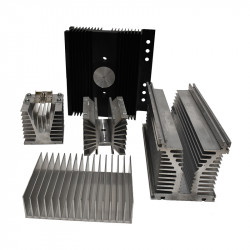
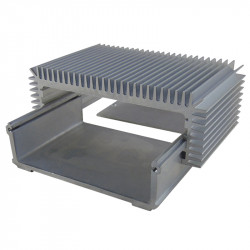
Heatsinks come in various shapes and sizes, adapted to the amount of heat they need to dissipate. A larger heatsink with densely spaced fins can dissipate more thermal energy and more effectively prevent overheating.
How does a heatsink work?
The operation of a heatsink is based on several basic physical phenomena. First, a heatsink is made of materials with high thermal conductivity, which allows heat to be quickly transferred from the component's surface. Second, the fins of the heatsink increase its surface area, allowing more efficient heat dissipation into the surrounding air.
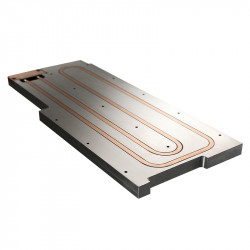
The heatsink disperses heat through convection and thermal radiation. For solutions requiring maximum efficiency, liquid cooling is also used, where the heatsink acts as a radiator and transfers heat to the circulating liquid.
Application of heatsinks in electronic devices
The use of heatsinks covers a wide range of devices – from personal computers to complex industrial systems. A heatsink is essential in CPU processors, graphics cards, power transistors, converters, controllers, and other electronic circuits. Heatsinks are often used where electronic components generate large amounts of heat, and system reliability is critical for safety and stable operation.
Thanks to its design, the heatsink plays a key role in temperature management and extends the lifespan of electronic components.
Heatsink materials and manufacturing process
Heatsinks are made from materials with high thermal conductivity, most often aluminum or copper. Aluminum is lightweight, inexpensive, and has good thermal conductivity, which is why heatsinks are usually made from this material. Copper, on the other hand, provides better thermal conductivity, making a copper heatsink more efficient, though more expensive and heavier.
The manufacturing process of a heatsink involves shaping the fins, which increase the heatsink's surface area and improve cooling efficiency. Heatsinks come in various shapes and sizes – from compact designs to large, heavy-duty radiators used in industrial equipment.
Passive and active heatsink
A passive heatsink operates without additional supporting elements, relying solely on conduction, radiation, and natural air convection. It is a quiet, reliable, and cost-effective solution used in systems with lower thermal loads.
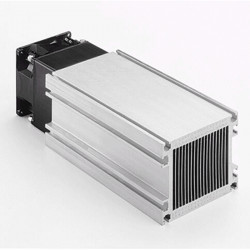
An active heatsink, combined with a fan, provides higher cooling efficiency and more effectively disperses excess heat. Such a system is crucial for maintaining stable operating temperatures in electronic devices generating large amounts of thermal energy.
Heatsink efficiency – what does it depend on?
The effectiveness of a heatsink and cooling performance depends on several factors:
- heatsink surface area and number of fins,
- materials used (aluminum, copper),
- quality of heatsink installation and the use of thermal paste, which fills microscopic gaps and improves heat transfer,
- presence of a fan or liquid cooling system,
- ambient temperature and airflow.
A heatsink ensures effective heat dissipation into the environment, but only when its design is matched to the amount of heat it needs to dissipate.
The heatsink is a key element for device reliability
The heatsink is a component whose role in managing the operating temperature of electronic components cannot be overstated. Without it, electronic devices could quickly overheat, leading to reduced performance, instability, or even permanent damage.
Thanks to the heatsink's design and its ability to efficiently conduct and dissipate heat, safe operating temperatures and long-term device reliability can be maintained.
Summary – why is the heatsink so important?
The heatsink is an essential component in every electronic system that protects components from overheating. Heatsinks are widely used, made from materials with high thermal conductivity, and designed to disperse heat as efficiently as possible. In cooperation with a fan or liquid cooling, the heatsink ensures stability and performance of electronic devices.
The heatsink is a key element that plays a role in heat management and prevents failures. Whether we are talking about processors, transistors, or power supplies, proper heatsink design is the foundation of the entire system's reliability.
We invite you to explore our offer, where you will find solutions tailored to various needs. Contact us to choose the heatsink best suited for your application.
Related products

Related posts
Thermally conductive materials in power storages
Technological development caused a need in electric engineering to search for new solutions in heat conduction.
Read more
Measuring power and energy in electric circuits
Power meters and network parameter analyzers are intended for identifying anomalies of power supply in single-phase...
Read more
Wentylatory przemysłowe - rodzaje, właściwości
W zależności od obiektu, charakteru stanowisk pracowniczych, oraz szeregu indywidualnych czynników otoczenia w...
Read more
Leave a comment